Skip to content


Parents have a tremendous amount of time to model for kids the distinction between right and wrong. Teach them to speak politely, to share, respect elders, and to follow good practices. However, there is also a lesson that can change the way they cope in life, which is understanding their feelings.
If a child knows how to see anger before it becomes aggression, he or she can discuss sadness rather than retreat, or explain how a friend might be hurt. This means he or she is learning emotional intelligence.
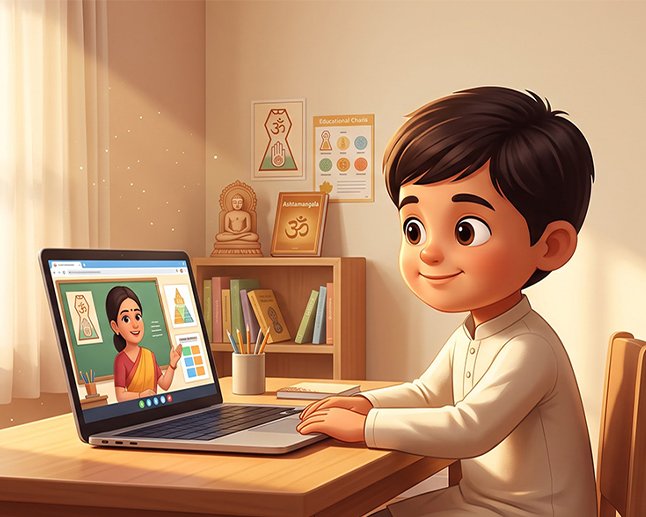
It’s a learning that can be seamlessly extended for Jain families. Jain principles provide children with a thought-provoking approach to self-understanding, reactions, and relationships. Digital Jain Pathshala introduces Jain values into the learning process in an age-appropriate manner, with an interactive approach and interesting stories.
What is Emotional Intelligence in Children?
Emotional intelligence is the capacity to identify, understand, and regulate emotions, and to sense the emotional state of others.
It’s so easy for kids when they learn how to:
- State, “I am angry because my friend took my toy.”
- Know when they need some quiet time.
- Say sorry to someone for hurting them.
- Recognise that a sibling might be sad even when they are not crying.
- Learn how to react in a different, calmer manner when things go wrong.
EQ for children is not a “do not cry” approach. Children will still have bad days, be frustrated, and have tantrums. The aim is to enable them to identify their emotions and slowly develop healthier responses.
Why Emotional Awareness Matters in Jain Parenting
The core values of Jain philosophy are awareness, self-control, compassion, and peaceful behavior. These values can easily be put into use during everyday situations in childhood.
For example, imagine a child becomes angry while playing a game. Rather than telling them, “Don’t get angry,” the parent might ask, “What went on inside of you when you lost?” This little question encourages self-observation.
Similarly, when children hurt each other, parents can help them think about how their sibling might have felt: “How do you think your sister felt when you said that?” This links emotional awareness directly to empathy and responsibility.
It is not about the “suppression” of feelings. It is about giving them time to reflect, to comprehend their responses, and to make conscious decisions about how to respond.
How To Teach Emotional Awareness At Home
Parents frequently have questions about how to teach emotional awareness without turning every conversation into an educational lecture. There’s no need for complicated activities. Everyday moments are more than enough.
1. Name a Feeling
Encourage your child to develop emotional language skills.
Rather than saying, “You are being bad,” say, “You appear to be frustrated. Things didn’t work out as you would like.” If a child does not know how to identify and name his or her emotions, they will not be able to manage them.
2. Listen Before Correcting
When a child is upset, your first response does not always need to be advice.
Allow them to tell you what occurred. If they feel they are being heard, they are generally more willing to consider how they could change their behavior.
3. Ask Questions That Encourage Reflection
Simple questions can help children focus on their inner state:
- How do you feel as you see this?
- What was it about this situation that made you feel like that?
- What do you think he or she was feeling?
- What would you change if you were to do it again?
These conversations slowly develop a deep awareness of oneself.
4. Model Healthy Emotional Behaviour
Children observe and learn a lot from their parents.
When you get angry, admitting it can have a huge impact: “I was annoyed and spoke too loudly. I should have taken a moment before speaking.” This demonstrates to children that emotional intelligence is a practice for everyone, regardless of age.
Storytelling to Ease Emotional Learning
Some lessons are easier for children to understand through a character than through direct instruction.
A story provides them with an opportunity to observe a situation without the feeling of being corrected. They can identify the character’s emotions, their responses, and the subsequent events.
This can be particularly helpful for Jain families. When parents want to teach children to be compassionate, patient, or self-aware, they can explore these traits through familiar scenarios.
Emotion Storybook Set
Digital Jain Pathshala’s Storybook Set 2 is incredibly useful for parents who want to introduce emotional learning through stories.
The set consists of pictorial storybooks that enable children to learn about their emotions, develop healthy relationships, and respond to situations with awareness. It creates a direct link between emotional awareness and Jain values.
When reading a story, parents can ask the following questions:
- “Have you ever felt the same way the character did?”
- “What would you have done in their situation?”
- “What would you have done differently if you were the character?”
Remember, reading time is not a test. A simple five-minute conversation is enough to help a child connect the story with real life.
Emotional Intelligence is a Skill
There are children who will share their emotions on their own. Others take longer. Some are assertive when they are angry, while some are silent when they are worried.
Parents should not make comparisons between these differences or expect all children to react in the exact same manner.
A child’s EQ is developed over time through repeated experiences, conversations, and modelling. The key is to establish a safe, comfortable environment for expressing feelings while keeping clear boundaries about behaviour.
A child can be told, “It is okay to feel angry. It is not okay to hurt someone because you are angry.”
That distinction is critical. Every emotion is valid, but not every action is.
Raising Children Who Are Aware, Not Perfect
The goal of Jain parenting is not to raise children who never become angry, jealous, disappointed, or impatient. That would be unrealistic.
The objective is to help children become more aware of these emotions and how they affect themselves and others, empowering them to make informed decisions and respond thoughtfully.
The concept of Digital Jain Pathshala aligns perfectly with the overall philosophy of Jain education. Its activities are designed to integrate Jain values with contemporary pedagogy, character development, and confidence building.
Jain values become a part of daily family life rather than lessons that need to be taught to children. They turn into values that they can identify and practice.