Skip to content

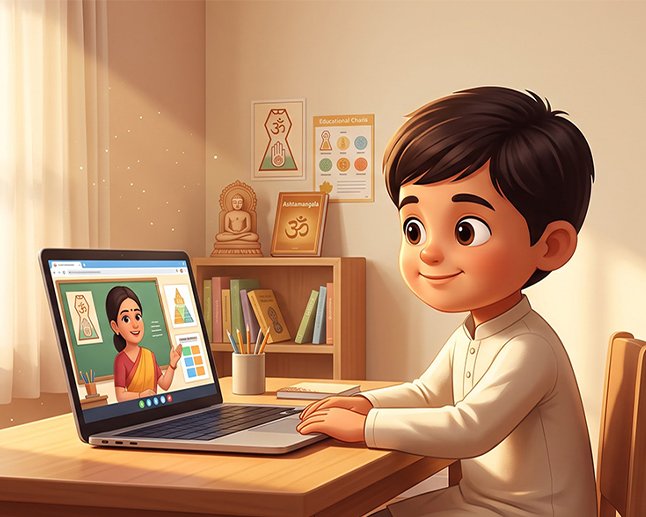
Today’s moms and dads are most likely in the same rut: A full day, a restless kid, and a quiet screen. It’s not all bad news when it comes to screen time. When screens are always the answer to boredom, mealtimes, transportation, or “winding down”.
However, limiting children’s screen time doesn’t have to be about deprivation. It can mean providing them with something more attractive to look at.
A well-written storybook can do just that. It provides a stimulus for children to enjoy a story, introduces new vocabulary, maintains a conversation and in a subtle manner conveys values in the context of daily activities. Stories can also be a natural way for jain families to help their children understand principles like compassion, honesty, self-control and kindness.
Why Reducing Screen Time Is Hard for Children
The purpose of a screen is to capture attention. They provide movement and sound and colour, and give immediate entertainment, whereas reading demands that a child slow down and engage in the activity.
Hence, merely stating “No more screens” may not be effective for all children.
Rather, parents can make appealing options that children will choose. When read together, viewing picture books, listening to stories before sleep, and/or setting up a small “reading corner” at home, reading can become a part of the fun of the day.
The aim isn’t to remove all screens. The goal is to establish a healthier balance, and not eliminate the use of screens as the primary source of entertainment.
Books vs. Screen Time: What Makes Reading Different?
Not all the time it’s about books versus screen time. It is the learning that children are taking from each activity.
A child is watching a video that is fast paced and provides pre-made visuals and sounds. Child will have to imagine characters, understand what is going on, follow the sequence and make connections when reading or listening to a story.
A storybook can thus be used to teach multiple skills.
| Storybook Experience | What Children Develop |
|---|---|
| Listening to a story | Attention and listening skills |
| Encountering new words | Vocabulary and language skills |
| Following a story | Comprehension and sequencing |
| Looking at illustrations | Observation and imagination |
| Understanding characters | Empathy and emotional awareness |
| Discussing the story | Communication and critical thinking |
| Reflecting on characters’ choices | Values and moral understanding |
| Retelling the story | Memory, confidence, and expression |
This is particularly important in the early years when children are learning to develop their language skills and understanding emotions, relationships and everyday behaviour.
Why Value-Based Books Matter
Values are transmitted to children through experience. It is a way for parents to present those experiences to their children in a simple way through characters and situations that the children can understand from the stories.
A story can demonstrate an act of kindness for a child rather than telling them to be kind.
A story can demonstrate the value of honesty by the consequences of someone choosing to be honest instead of convenient when it is not explained in a lecture.
This brings value-based books for children beyond the realm of education. They can be a way to start a conversation with your child.
After a story, a parent can ask:
- “What would you have done?”
- “Was the character’s choice right?”
- “How do you think the other person felt?”
- “Have you ever been in a similar situation?”
These small conversations can help children connect a story’s lesson with their own lives.
Jain Stories Can Make Values Easier to Understand
Storytelling is also an opportunity for the Jain families to introduce the principles of Jainism in a subtle way.
Abstract thoughts and philosophical explanations might not be understood immediately by young children. Stories help to concretize those ideas.
The child can perceive a character’s compassion through their actions. They are able to comprehend the impact of their actions on others. They are able to identify the value of telling the truth, managing anger and caring for living things.
It’s important to keep these conversations age-appropriate. Kids don’t require high level explanations to start developing a relationship with values. They require stories that make sense to them; they require characters with which they can identify; they require adults who will discuss the meaning of the stories.
Storybooks Can Build Vocabulary Without Feeling Like Learning
Storybooks that can help build vocabulary, without the feeling of learning.
There is no need to use worksheets and word lists to develop vocabulary.
Children are introduced to new words in the context of stories naturally. A child might be able to determine the meaning of a new word when they see it in a character, event or picture, because of the context of the story.
This can be made even more useful by parents taking time out periodically.
“What is the meaning of this word?”
In your opinion, what seems to be going on here?
Can you say that word in your own sentence?
These are basic questions that transforms reading time to an informal language building exercise.
Children should read books regularly over time as it helps them to make new words familiar and to formulate ideas.
How to Reduce Screen Time for Kids Without Daily Battles
Don’t make changes to your child’s routine overnight. Sometimes it’s easier for the whole family to make small changes.
1. Make a time predictable for reading
Bedding habits can be an easy habit of 10 to 15 minutes before going to sleep at night.
2. Keep books within easy reach
When children can see and access a book, they are more likely to select it.
3. Let children choose
Allow them to choose some of the material they read. Choices can make reading more fun.
4. Read together
The tone of your voice, your expressions and questions can make a story much more interesting for your younger children in particular.
5. Quit one screen time habit at a time
If your child is accustomed to watching videos when waiting for dinner, offer a story book instead. Not all screen time activities need to be eliminated at once.
6. Talk about the story
Reading can be a meaningful activity for the whole family rather than passive entertainment with a few minutes of conversation.
Making Jain Storytelling a Part of Everyday Family Life
Jain learning does not have to be limited to formal classes.
At bedtime a story may include a value. That value could be tied to an encounter that took place in the day during dinner. When a child asks a question during a family outing, he or she can be reminded of the same principle in the real world.
This allows learning to happen more naturally.
It also takes away the pressure from parents of teaching Jain values at all times. At times, a good story can start the discussion.
Turn Reading Into a Screen-Free Family Ritual
You can make story time simple and consistent:
Pick a time → Choose a story → Read together → Talk about one value → Connect it to everyday life
The discussion does not need to be extended. One question can linger in a child’s mind.
If you are telling a story about compassion, you could ask them, “What is one kind thing we can do for someone today?
This is where reading gets more interesting!
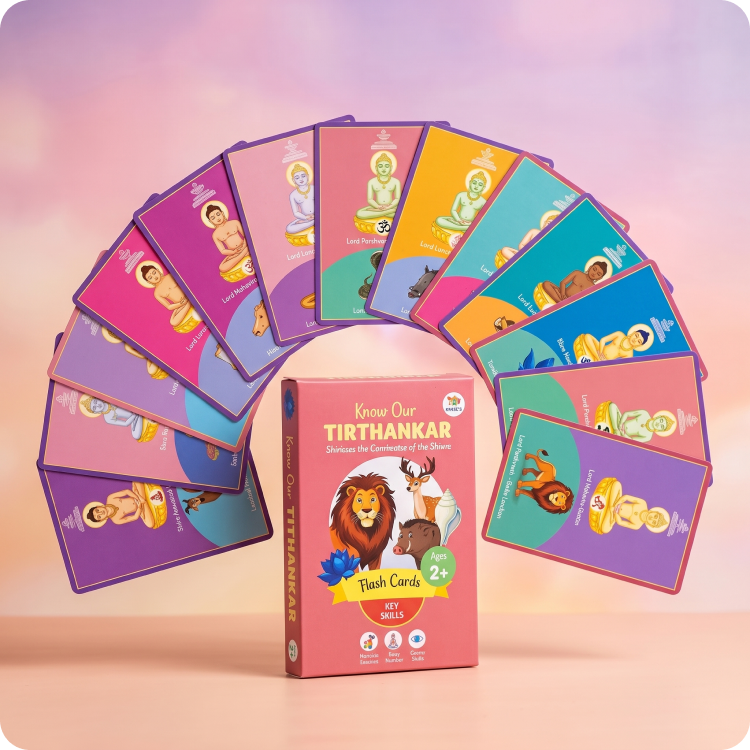
Jain Storybooks from Digital Jain Pathshala
The sets of storybook are created by Digital Jain Pathshala to make children feel the Jain values through story way, that is accessible and enjoyable.
For any parent who is seeking to add something to their child’s reading regimen, this is a great way to do it, particularly Set 1 and Set 2.
Storybooks are used to provide children with characters, situations and choices to consider rather than to “read” values.
They can also be a good launching pad from which parents can talk to their children about the principles of the Jains in a language that the children can relate to.
This could be a good one for families who are looking to cut back on screen time for their children, but more than just a time with less screen, it’s about spending quality time together reading, talking and learning.
A Better Question Than “How Much Screen Time?”
Parents tend to think about the amount of time the kids spend on screens. That’s important, but there’s one more important question worth posing:
What do my child do when they’re not on a screen?
The less time spent on screen, the more time there will be to share stories, discuss, engage in creative play and family interaction and provide meaningful learning.
One can’t out-shout and out-run another with his book. It is something different, it is time to imagine, understand, ask questions and connect.
But when that book takes values that are important to your family, reading can be a component of living those values, rather than just teaching them.
Final Thought
It doesn’t have to be another struggle at home to cut back on screen time. At times, it’s more effective to make the other option desirable.
Story time can entertain a child and teach him or her new words, values and conversations with the people they love.
For Jain parents, it’s all the more significant when it comes to story time. A few quiet minutes spent with a book can be transformed into a chance to build vocabulary, develop values and make Jain learning a part and parcel of family life with the help of Set 1 and Set 2 from Digital Jain Pathshala.